
Nissan Safety System Service: When Do Cameras and Sensors Need Calibration?
Modern Nissan vehicles can do much more than get you around Grand Rapids and West Michigan. Depending on the model and available equipment, Nissan driver-assistance technology can help monitor traffic, detect vehicles around you, maintain your position in a lane, and provide warnings when certain hazards are detected.
Features such as ProPILOT Assist,
Automatic Emergency Braking, Intelligent Blind Spot Intervention, Lane
Departure Warning, and Intelligent Around View Monitor can rely on cameras,
radar sensors, sonar, and other vehicle systems working together.
Most of the time, these technologies
operate in the background without requiring much thought from the driver.
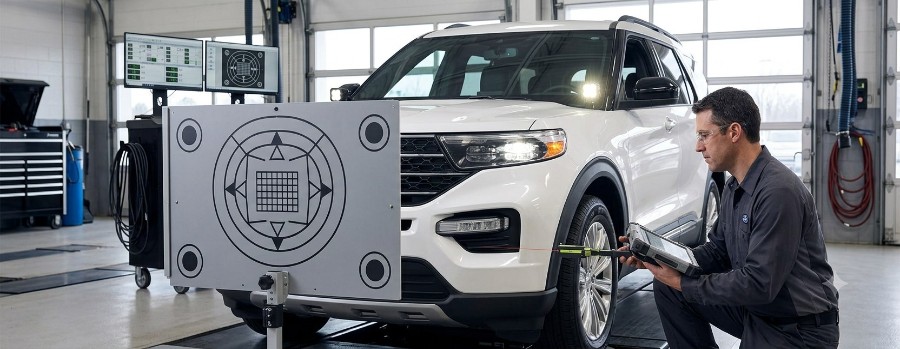
But situations such as a windshield
replacement, collision, bumper repair, wheel alignment, or an ADAS warning can
mean the system needs to be inspected or calibrated.
That is where proper Nissan camera
calibration and Nissan sensor calibration can become important.
At Fox Nissan Grand Rapids, our service
team provides Nissan maintenance, repairs, and diagnostics to help identify
issues affecting your vehicle's driver-assistance technology. If your Nissan is
displaying an ADAS warning or a driver-assistance feature is not operating as
expected, our team can help determine what may be causing the problem.
What Is ADAS and Why Does Your Nissan Need It?
ADAS stands for Advanced Driver
Assistance Systems.
These systems use a combination of
cameras, radar sensors, sonar, vehicle sensors, and computer systems to monitor
conditions around the vehicle and provide information or assistance to the
driver.
Depending on the Nissan model and
equipment, these technologies can support features such as:
·
Automatic Emergency
Braking
·
Intelligent Forward
Collision Warning
·
Lane Departure Warning
·
Intelligent Lane
Intervention
·
Intelligent Blind Spot
Intervention
·
ProPILOT Assist
·
Intelligent Cruise
Control
·
Rear Cross Traffic Alert
·
Intelligent Around View
Monitor
The exact technology varies by Nissan
model, model year, and trim.
For example, certain Nissan
driver-assistance systems use a front camera to monitor lane markings and other
information ahead of the vehicle, while radar can be used to detect vehicles
and estimate their distance and movement. Other Nissan models may use
additional cameras, radar sensors, or sonar depending on their equipment.
Because these systems depend on accurate
information from their sensors, their components need to remain properly
positioned, unobstructed, and functioning according to Nissan specifications.
When Does a Nissan Need Camera or Sensor Service?
There is no single mileage interval that
means every Nissan needs ADAS calibration.
Instead, inspection or calibration may be
necessary after certain repairs, changes, or conditions involving the systems'
cameras and sensors.
1. Windshield
Replacement
Some Nissan models use a camera mounted
behind the windshield.
If the windshield is replaced, work
around the camera can affect its position or the conditions under which it
operates. Depending on the specific Nissan model and repair procedure,
calibration or other system checks may be required.
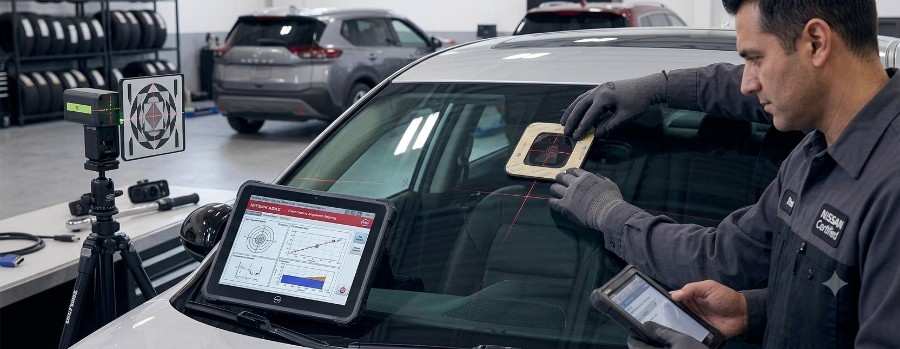
This is one reason it is important to
follow the applicable Nissan repair procedures rather than assuming the camera
will automatically be correctly aligned after glass replacement.
2. Collision or
Front-End Repairs
A collision can affect ADAS components
even when the damage is not immediately obvious.
Radar sensors may be located behind or
around the front bumper area, while cameras and other sensors can be positioned
throughout the vehicle.
An impact, bumper repair, replacement of
a component, or damage to a sensor mounting area can potentially affect the
system.
Nissan's collision-repair guidance calls
for the applicable calibration procedure when certain ADAS components are
removed or replaced and identifies vehicle alignment among conditions that can
require calibration, depending on the specific vehicle and system.
3. Wheel Alignment or
Suspension Work
Modern ADAS systems do not operate
independently of the rest of the vehicle.
Changes involving wheel alignment,
steering, suspension, or sensor positioning can affect systems that depend on
the vehicle's orientation and sensor information.
That does not mean every alignment
automatically requires ADAS calibration. The appropriate procedure depends on
the Nissan model, the system involved, and the work performed.
4. ADAS Warning Messages
Your Nissan may display a warning when a
driver-assistance system is temporarily unavailable or detects a problem.
Sometimes the cause is simple.
Cameras and radar sensors can be affected
by conditions such as dirt, snow, ice, heavy rain, fog, or direct sunlight.
Obstructions around sensor areas can temporarily prevent certain systems from
operating.
If the warning remains after the
obstruction or environmental condition has cleared, the vehicle should be
inspected.
What Is Nissan Camera Calibration?
A camera needs to be positioned and
configured correctly so the vehicle's computer can interpret the information it
receives.
Nissan camera calibration is the process
of setting up or calibrating a camera-based driver-assistance system according
to the requirements for the particular Nissan model and system.
The exact procedure varies by vehicle.
Depending on the system, calibration may
involve specialized targets, measurements, diagnostic equipment, software, and
specific workshop conditions.
It is not simply a matter of pointing the
camera in approximately the right direction.
For example, Nissan driver-assistance
systems can use front cameras to identify information such as lane markings and
objects around the vehicle. If the camera's position or calibration is
incorrect, the information being supplied to the vehicle's control systems may
not be interpreted as intended.
What Is Nissan Sensor Calibration?
Cameras are only one part of Nissan's
driver-assistance technology.
Depending on the vehicle, ADAS can also
use radar sensors, side sensors, sonar, and other components.
Radar can help detect vehicles and
determine information such as their distance and relative movement. Other
sensors can help monitor areas around the vehicle for vehicles or obstacles.
Nissan sensor calibration involves
ensuring the relevant sensor system is correctly set up according to the
applicable Nissan procedures.
This is particularly important when
repairs involve areas where ADAS sensors are mounted.
When calibration is required, following
Nissan's applicable repair procedures and using the appropriate diagnostic and
calibration equipment helps ensure the system is serviced according to the
vehicle manufacturer's requirements.
Why ADAS Calibration Matters After a Collision
After an accident, visible damage is
usually the first thing drivers notice.
A damaged bumper, cracked grille, dented
body panel, or broken headlamp is easy to see.
But modern Nissan vehicles can also have
important sensors and cameras positioned behind or around these components.
That means repairing the visible damage
is not necessarily the end of the process.
If an ADAS component has been removed,
replaced, moved, or affected by a collision repair, the vehicle may require
additional diagnostic checks or calibration based on Nissan's procedures.
This is why Nissan driver-assistance
service should involve more than simply clearing a warning light.
The goal is to determine whether the
relevant systems and components are operating according to the requirements for
your particular Nissan.
Fox Nissan Grand Rapids also has a
collision center that handles vehicle body repairs and works with insurance
companies during the repair process.
Keep Your Nissan's Driver-Assistance Technology Working
Properly
Driver-assistance technology is designed
to support the driver, but these systems have limitations and are not a
substitute for attentive driving.
Environmental conditions, including snow,
ice, heavy rain, fog, dirt, direct sunlight, and poor visibility, can affect
the operation of certain driver-assistance systems. Keeping camera and sensor
areas clean and addressing persistent warnings can help the systems operate as
intended.
If your Nissan has recently had a
windshield replaced, been involved in a collision, received repairs near a
sensor, undergone relevant alignment work, or started displaying an ADAS
warning, it is worth having the vehicle properly inspected.
Whether the solution involves diagnosis,
cleaning, repair, software procedures, or Nissan camera or sensor
calibration, the correct procedure depends on your vehicle and the system
involved.
At Fox Nissan Grand Rapids, we're here to help keep your Nissan's technology, performance, and safety systems working as intended.